
Build a simple hair moisture routine you can keep
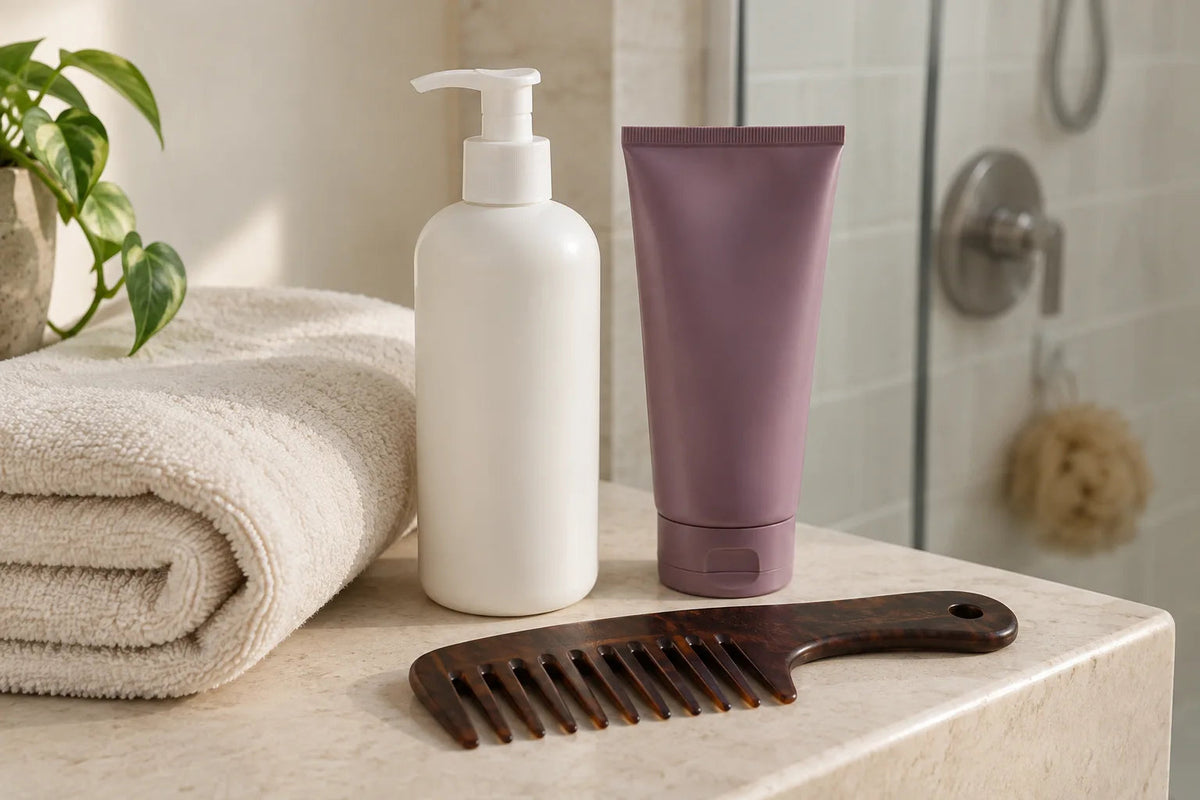
A useful hair routine should fit your hair, your schedule and your budget. It need not involve a shelf of overlapping products or a complicated sequence copied from someone with different hair. Start by separating two questions: what does your scalp need from cleansing, and what do your lengths need to feel manageable? The answers may be different.
This is a practical framework for everyday cosmetic care. It is not a treatment plan for scalp symptoms, and it does not assume that a particular ingredient or routine works for everyone.
Take stock before buying anything
Write down the products you already use and what each one is supposed to do. Separate shampoo, rinse-out conditioner, leave-in products, styling products and optional oils. Two bottles with different names may be filling the same role. Note which steps you like and which leave your hair feeling coated, difficult to detangle or awkward to style.
Choose one realistic goal. “I want wash day to feel less rushed” or “I want to understand whether I need a leave-in” gives you something you can assess. A promise of instant transformation does not. You can make a useful first change by organising your current routine before purchasing anything new.
Build a cleansing step around your scalp
There is no single wash calendar for all hair. The American Academy of Dermatology advises adjusting washing to how dirty or oily your hair gets, and concentrating shampoo on the scalp. Use the product according to its directions and rinse thoroughly. A schedule that suits someone with an oily scalp may be very different from one that suits dry, textured hair. AAD: tips for healthy hair
Think about the circumstances around your routine: swimming, exercise, frequent styling and a change in products can all give you reasons to reassess how the routine feels. This is not an instruction to wash more often after every activity. It is a reminder to pay attention to your own experience rather than treating a calendar as a rule you must obey.
Make conditioning a deliberate step
Check whether your conditioner is intended to be rinsed out or left in, how much the manufacturer recommends and where it should be applied. Do not assume a longer contact time is better. Set aside enough time to follow the instructions, especially when a rushed wash tends to leave you skipping steps or rinsing inconsistently.
If you have curls or coils, the AAD's curly-hair guidance recommends conditioning through the hair and working in sections when detangling. Use a suitable wide-toothed comb or your fingers without forcing through knots. Those general principles matter more than buying every product in a named multi-step method. AAD: curly and coily hair care
Decide whether an extra layer has a purpose
A leave-in, oil, cream and styling gel are separate choices. You do not need to add all four to qualify as having a proper routine. Ask what is missing after cleansing and conditioning: styling hold, a particular finish, or simply more time to detangle carefully. Then read the directions for a product designed for that job.
Try one change while keeping the other steps familiar. For instance, compare your usual routine with the same routine plus a leave-in used as directed. Record how it feels after styling and before the next wash. If you also change the shampoo, introduce an oil and use a different heat setting, the comparison becomes much less informative.
Keep a small routine record
You do not need an app or a daily photograph. A note with four fields is enough: wash date, products used, approximate amount and one observation. Use descriptions such as “easy to comb”, “finish too heavy” or “liked the feel on day two”. Avoid interpreting ordinary changes in appearance as proof of a medical effect.
After several uses, look for a practical pattern. A product that is pleasant but time-consuming may belong in an occasional routine. A simple combination that fits an ordinary weekday might be the one worth keeping. Discarding an unnecessary step is progress, even when it is the step most often promoted online.
Plan for busy days
Set out what you actually use together: shampoo, conditioner, an appropriate detangling tool and a towel. Keep the directions available, rather than decanting into an unlabelled container. When travelling, take familiar products if possible and retain their ingredient and usage information.
Choose a realistic time for the complete routine. If you regularly start too late and rush drying or styling, moving wash day can be more useful than purchasing another mask. Keep any optional finishing step optional. The routine should support your day, not become a test you feel you have failed.
Know when a shopping change is not the answer
Persistent scalp discomfort needs a different response from hair that simply feels too coated. The NHS advises a GP review when the scalp is red or swollen, very itchy, or dandruff has not improved after appropriate self-care. A retailer should not diagnose the cause or keep suggesting more oils. NHS: when to get help for dandruff
If your scalp is comfortable and you are comparing cosmetic finishes, keep the experiment small. Read our jojoba oil guide before adding an oil, or the extension aftercare checklist if your routine needs to work around fitted or removable hair. Start with a clear purpose, follow the relevant instructions and keep only the steps that are useful to you.