
Hair oils and jojoba: a practical buying guide
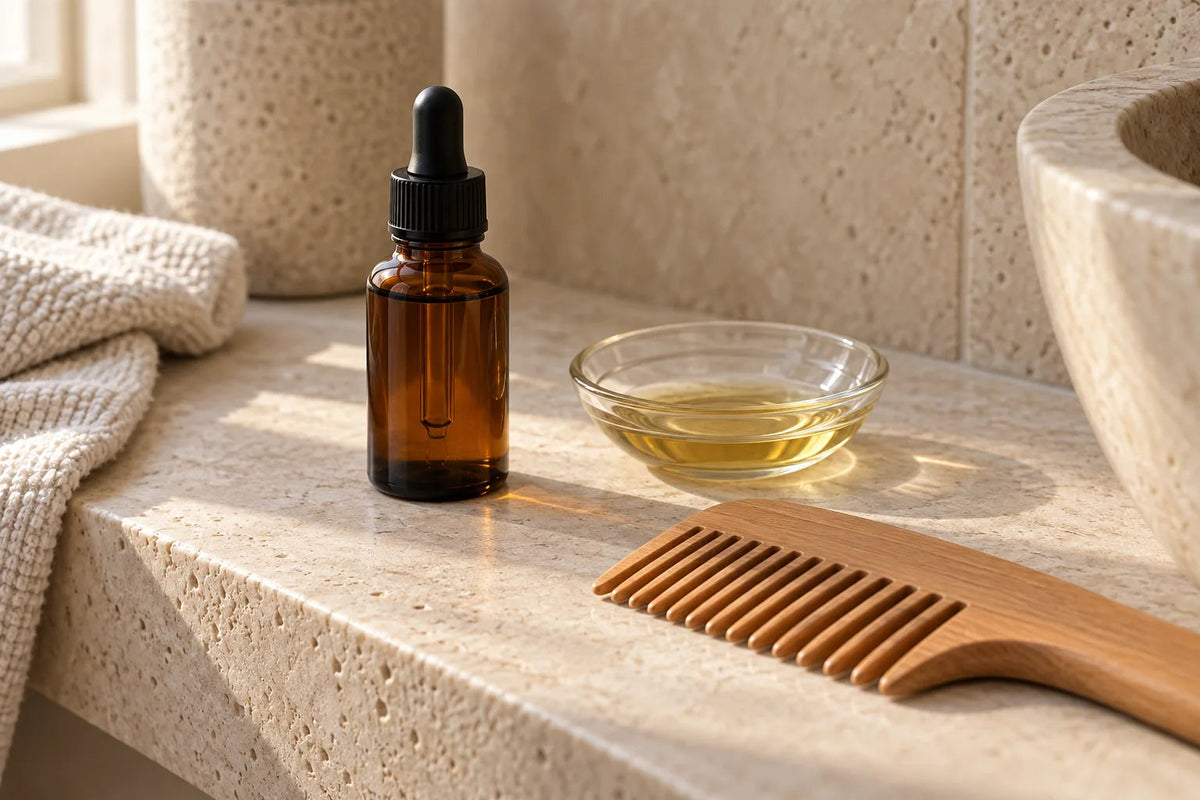
Jojoba oil appears in single-ingredient bottles, blended hair oils, conditioners and finishing products. Those formats do different jobs. Before choosing one, decide what you want to change: perhaps your ends feel rough after styling, you want a less heavy finishing step, or you are comparing ingredients in two products. A clear purpose is more useful than buying an oil because a video promises dramatic results.
This guide is about cosmetic care and informed shopping. It does not recommend jojoba as a treatment for dandruff, hair loss or a scalp condition, and we have not tested or ranked the products discussed.
First, identify what is in the bottle
On an ingredient list, jojoba commonly appears as Simmondsia Chinensis Seed Oil. Despite its familiar name, it is a liquid wax obtained from jojoba seeds. The cosmetics industry's COSMILE Europe database lists hair conditioning among its cosmetic functions. That describes an ingredient's role; it does not establish how every finished product will perform on your hair. COSMILE Europe: jojoba ingredient information
A single-ingredient oil is different from a blend that includes fragrance, other oils or additional conditioning ingredients. Read the complete list rather than relying on the ingredient pictured on the front. Also check whether the label describes a leave-in finish, a rinse-out step or a scalp product. Products with similar names can have quite different directions.
Comparing jojoba, coconut, castor and olive oils
These ingredient names are a starting point, not a complete buying decision. For any of them, compare whether you are looking at a single oil or a blend, where the product is intended to be applied and how it should be removed. An older recommendation for one named oil does not establish that a different bottle has the same formula or instructions. Choose a cosmetic product for its stated use rather than substituting a kitchen ingredient or assuming all oils are interchangeable.
Give it a specific job in your routine
An oil is an optional addition, not a reason to abandon a shampoo and conditioner that already suit you. If you want to try it, identify one point in your existing routine where the manufacturer's instructions suggest it belongs. Avoid adding an oil, a new mask and a new styling cream together; you will have little idea which change made the difference.
For example, someone happy with their wash routine might want to compare the feel of their dry ends with and without a finishing product. Someone whose hair already feels coated may prefer to review how much of their existing products they use before adding another layer. These are ways to organise a trial, not promises about what jojoba will do.
Start with the label, not an internet recipe
There is no universal number of drops for every head of hair or every formula. Follow the product's directions, including whether it should be used on wet or dry hair and whether it must be rinsed out. Begin with the smallest amount within those directions and avoid changing several steps at once.
Measure your experience in ordinary terms: does your hair feel comfortable, does the finish suit you, and is your next wash manageable? A simple note such as “used after conditioning; ends felt too coated” is more useful than trying to reproduce somebody else's photograph. Lighting, styling and editing make before-and-after images poor substitutes for your own observations.
Think separately about hair lengths and scalp
A product intended for the lengths is not automatically intended for the scalp. Read where the manufacturer says to apply it. Do not assume that more oil is the answer to itching or flaking. The NHS explains that dandruff can have several causes and advises seeking help for a very itchy, red or swollen scalp. NHS dandruff guidance
If a product causes a reaction, stop using it. For products intended for skin contact, the American Academy of Dermatology provides a small-area testing approach; the product's own warnings still matter, and a home test cannot guarantee that a reaction will never happen. AAD guidance on testing a new product
Check compatibility with extensions
If you wear fitted extensions, ask your installer which products are compatible with the specific attachment system. A product that suits your own ends may not be appropriate around a bond, tape or other fitting. Bring the ingredient list and application instructions to the conversation rather than asking whether all “natural oils” are suitable.
For removable pieces, follow their separate care instructions. Human-hair and synthetic extensions should not be treated as interchangeable. Our extension aftercare guide gives you a practical list of questions to ask before installation and at maintenance appointments.
Compare the whole purchase
Bottle size is only one part of value. Compare the price per 100 ml, the ingredients, intended use, packaging and directions. A fictional £12 bottle containing 30 ml costs £40 per 100 ml; a £20 bottle containing 100 ml costs £20 per 100 ml. That calculation helps compare quantity, but it does not make the larger bottle a better formula or a better match for you.
Consider how much you will realistically use within the labelled period after opening. A small bottle can be a sensible first purchase if you are unsure whether an oil fits your routine. Check storage instructions and close the container after use. Neither an elaborate bottle nor a long ingredient story replaces clear information.
Keep the useful step and leave the rest
At the end of your trial, ask whether the oil solved the cosmetic problem you actually set out to address. If it added time and expense without a useful change in feel or manageability, it does not need a permanent place on your shelf. If it worked well, keep the rest of the routine stable instead of immediately adding more.
For a broader starting point, read our simple moisture routine. The aim is a set of steps you understand and can repeat, with each product earning its place.